
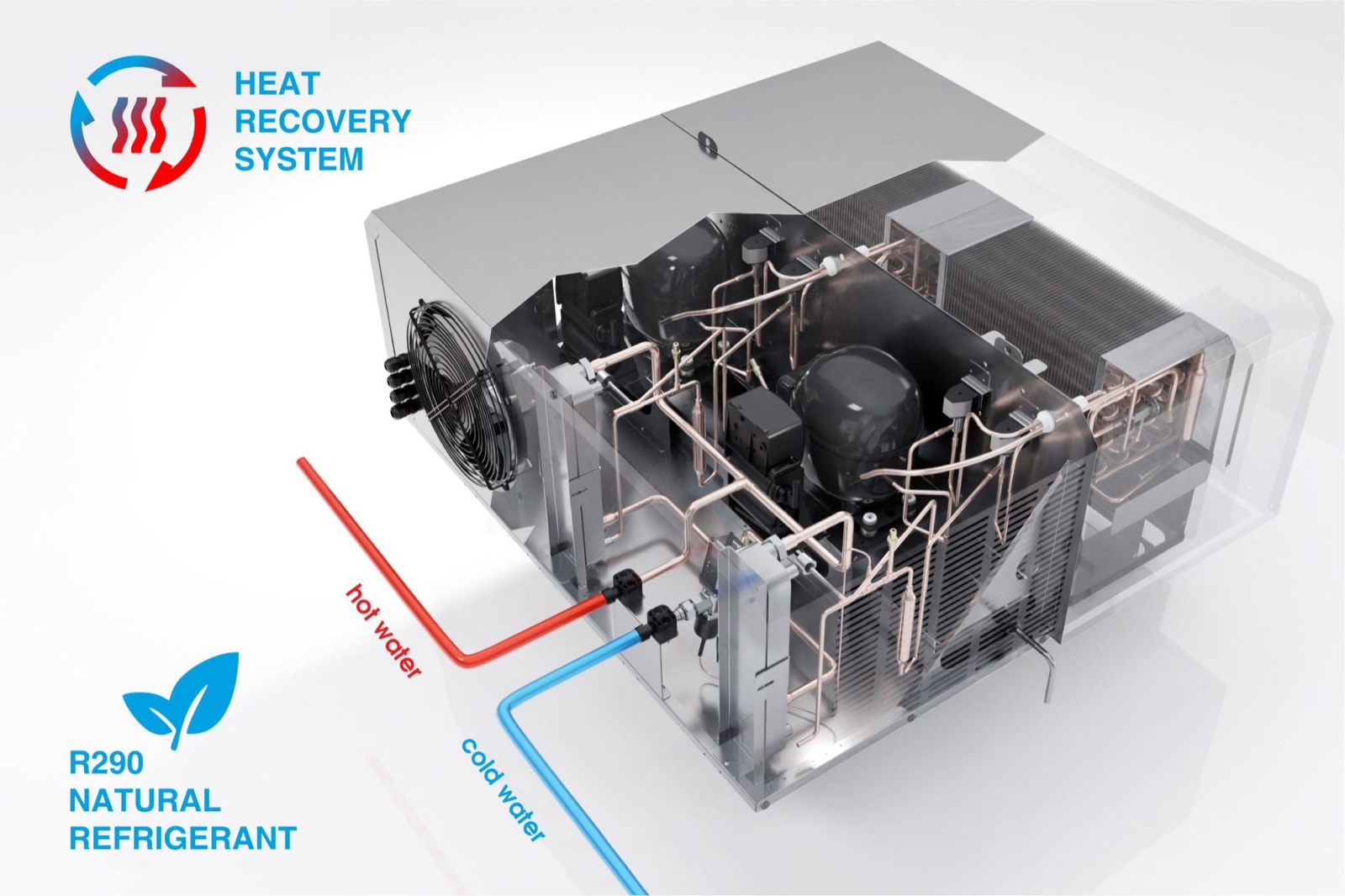
The refrigeration industry is going through its biggest shift in years – moving away from synthetic refrigerants with a high global warming potential (F-gases) towards natural ones. R290, or propane, is leading that shift. Here is why it is now the standard rather than a curiosity.
What is R290 and why is it gaining ground?
R290 is pure refrigerant-grade propane – a natural hydrocarbon with excellent thermodynamic properties. In practice that means high cooling capacity with a smaller refrigerant charge in the circuit, and a very low GWP (global warming potential) of just 3.
By comparison, the synthetic refrigerants that used to be common reach GWP values in the thousands. Switching to R290 therefore genuinely reduces the carbon footprint of a refrigeration system, with no compromise on efficiency.
F-gases, registers and charges – what do the regulations change?
F-gas regulations are gradually limiting the availability and raising the cost of synthetic refrigerants (the phase-down mechanism). Equipment charged with F-gases also carries additional administrative obligations.
An R290 monobloc simplifies day-to-day operation because it:
- does not require the unit to be entered in the national operators' register,
- does not generate the emission charges linked to F-gases,
- is not subject to the rising costs and supply limits affecting synthetic refrigerants.
Safety when working with propane
Propane is flammable, so units are designed to keep the refrigerant charge small and safe, with a hermetic construction that complies with the relevant standards. In a monobloc the circuit is factory-sealed and tested, which minimises risk and makes plug & play installation straightforward.
As a result, installation comes down to mounting the unit and connecting the power – with no work on the refrigeration circuit on site.
R290 in AiCool monoblocs
Every AiCool monobloc – for cold rooms, counters, cabinets, display cases and vending machines – runs on R290. We combine it with energy-efficient EC fans and (optionally) inverter compressors to bring running costs down as far as possible.
Frequently asked questions
Is R290 safe?
Yes – provided the design rules are followed. In a monobloc the refrigerant charge is small and the circuit is factory-sealed and standards-compliant, so plug & play installation is safe and requires no work on the circuit on site.
Do I have to register an R290 unit in the operators' register?
No. Registration obligations and emission charges apply to F-gases. Units running on the natural refrigerant R290 are exempt.
Is R290 as efficient as synthetic refrigerants?
Yes, and often more efficient. Propane has excellent thermodynamic properties, delivering high cooling capacity with a smaller charge in the circuit.
See how we build our units.
Explore the technology